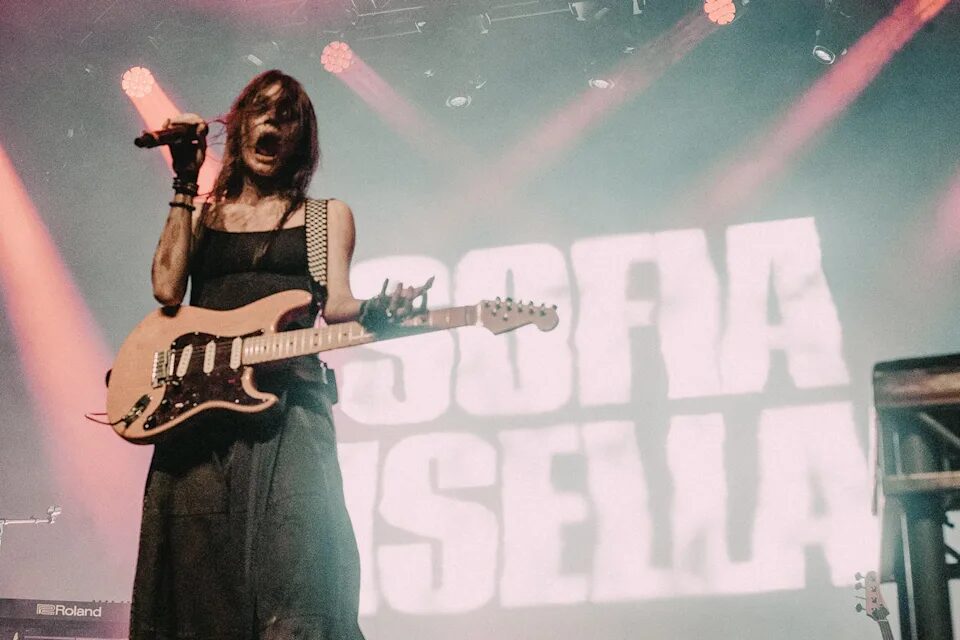
There was a moment at Sofia Isella’s Dublin gig where she looked out at the crowd and said something like:
“It’s so strange seeing so many grown ass men at my concert.”
Now, as one of the grown ass men in question, I had a split second where I had to decide how to take that.
I am 43. I was there with my wife. I may have been the only person in the room wearing a Sofia Isella T-shirt, which is either admirable commitment or a cry for help depending on your level of cynicism. Either way, I was not there ironically. I was not there because I had been dragged along. I was not there performing allyship for social credit.
I was there because I love her music.
Still, for one brief moment, I hesitated.
Part of that was because I had recently seen another young female artist talking online about older men attending her gigs, and it was not said with the same warmth. It felt suspicious, accusatory, like men of a certain age being present in that space was automatically a bit weird. She later clarified that it was more about behaviour, filming, photographing, being creepy, and that distinction absolutely matters. But the first version still stung a bit. Not because men are owed comfort in every space. We are not. But because it is a strange feeling to love someone’s art and then feel, even briefly, like the artist might look at someone like you and think: what are you doing here?
So when Sofia said it, I paused.
Then I realised she seemed amused. Maybe surprised. Maybe even delighted. It did not feel like “why the hell are you here?” It felt more like “look at this, isn’t this brilliant and ridiculous?”
So I raised my arms and cheered.
A couple of women behind me tapped me on the back and gave me a thumbs up, which was sweet, affirming, and also very funny. There I was, a fully grown man, being gently approved by the room for enjoying the angry young woman correctly.
I will take my wins where I can get them.
The Strange Thing
The strange thing is not that a 43-year-old straight man would enjoy Sofia Isella.
The strange thing is that this is strange.
Or, more accurately, the strange thing is that society has made it strange. Because somewhere along the line, men, especially straight men, have been trained to treat art by women, queer people, and especially angry women, as something that is either not for us, beneath us, threatening to us, or only acceptable if it has first been softened, sexualised, depoliticised, or filtered through male approval.
That is the bit I cannot get on board with.
Sofia Isella’s music is sharp, theatrical, funny, furious, accusatory and often deeply uncomfortable. She has the energy of someone who has read the room, hated the room, taken notes on the room, and then set the room on fire using a violin bow and a thesaurus. There is no great effort to make men comfortable. There is no apologetic smoothing of the edges. She is not asking to be found agreeable.
That is precisely the appeal.
“Everybody Supports Women” was probably the first song of hers that properly got under my skin, even if “Doll People” feels closer to the argument here. “Everybody Supports Women” circles around the conditional ways women are encouraged to distance themselves from other women, the “I’m not like her” instinct, internalised misogyny, and the social reward system built around being the acceptable woman.
“Doll People” feels more tied to the artificiality of how women are displayed, consumed, judged, flattened and expected to perform.
But more than any single song, it is the totality of the thing that pulls me in. The anger. The intellect. The drama. The sense that the performance is not a mask hiding the seriousness, but the delivery system for it.
I like that she does not soften the message.
I like that she does not sound grateful to be allowed a voice.
I like that she seems to understand something many people still pretend not to: sometimes the only sane response to a deranged world is theatrical rage.
The Approved Lane
Part of why these spaces feel so comfortable to me is that traditional male spaces often do not.
That does not mean I hate men, or that I do not have male friends, or that I have never enjoyed the comfort of a pub, a match, or a room full of lads talking nonsense. Of course I have. I still do.
But there is a version of male culture that is exhausting. The one with its tiny little rules. The approved lane. The unwritten list of things you are allowed to like, and the much longer list of things you are allowed to like only as a joke.
When I was younger, I liked Enya. I liked Spice Girls. I liked All Saints. I liked Alanis Morissette. I liked pop music. I liked songs that were dramatic, emotional, feminine, glossy, wounded, angry, ridiculous, or sincere.
But that was not exactly encouraged.
Anything remotely feminine was fair game. At best, it was treated as a joke. At worst, it was “gay”, thrown around with all the casual cruelty of teenage boys who had no idea what they were saying, only that it worked. It shut things down. It marked the boundary. It told you where not to stand.
And at that age, I did not have the bravery or the vocabulary to push back. I did not have the language to say: actually, this song is brilliant. Actually, your idea of taste is tiny. Actually, being afraid of women singing pop songs is not the alpha-male position you seem to think it is.
So, like a lot of young men, I drifted towards what was safer.
Not guitars. Guitars were never the problem. I love guitars. Some of my favourite artists make glorious, filthy, furious, beautiful guitar music. The problem was not the instrument. The problem was the lane.
A very specific lane of male-led guitar music was treated as the respectable option. The safe option. The thing that said you had taste without making you vulnerable. You could like that openly. You could build an identity around that. You could stand in a room full of other young men and not have to explain yourself.
Meanwhile, anything coded as feminine had to be smuggled in under irony, nostalgia, or silence.
There is a difference between liking something and hiding behind it.
As I have got older, I have become less interested in negotiating with imaginary men in imaginary rooms about whether my taste is acceptable. I like what I like. And increasingly, what I like is female-led, queer-coded, emotionally open, politically sharp, sad, euphoric, theatrical, furious, funny, and absolutely not interested in centring male comfort.
Which, when you say it out loud, sounds less like a midlife crisis and more like good taste.
The Artists Who Make the Room Bigger
Sofia was the catalyst for this essay, but she is not an isolated case.
Chappell Roan is a huge part of it. The camp is part of the appeal, obviously. The theatricality, the spectacle, the sense that pop music can be ridiculous and sacred at the same time. But the thing that really gets me is her refusal to back down. She feels like an artist who understands that visibility without self-possession is a trap. She is not just performing freedom. She is insisting on it.
Phoebe Bridgers and Lucy Dacus hit a different nerve. There is a quiet precision there. A sadness, yes, but also a clarity. They articulate things that men are often trained to bury under jokes, anger, or silence. It is not that men do not feel those things. It is that many of us are taught to treat emotional literacy as a foreign language and then act surprised when we cannot communicate.
MUNA, and Katie Gavin in particular, are another strand entirely. First and foremost, the music absolutely slams. That matters. Sometimes the political argument is that the song is simply a banger and everyone else should stop pretending otherwise. But underneath the hooks there is cutting lyricism, queer joy, longing, release, community, and a sense of being fully alive in a world that keeps asking people to make themselves smaller.
Then there is CMAT.
CMAT is glamorous, yes, but not in a distant, untouchable way. She is glamorous in a way that seems to arrive with one heel broken, one eye on the joke, and one hand still clutching whatever emotional damage she has decided to turn into a chorus. She is funny, self-aware, melodramatic, deeply Irish, deeply wounded, deeply unserious until she suddenly is not.
But she is also a victim of her own celebrity, and of the disgusting way some people respond to women who do not conform to the body image they expect from female performers.
“Take A Sexy Picture Of Me” epitomises so much of what I despise about that. The misogyny is not hidden. It is not subtle. It is right there in the open: the demand that she be attractive in the correct way, available in the correct way, shaped in the correct way, grateful in the correct way. A woman becomes famous, brilliant, funny, successful, adored, and still there are men lining up to tell her she is doing womanhood incorrectly.
You can tell it hurts her.
But she fights back in her own inimitable way, with humour, melody, glamour, venom, self-awareness, and a chorus big enough to carry the wound without letting it win.
That, maybe, is the thread.
Not perfection. Not polish. Not palatability.
Freedom.
Alanis Morissette, Tori Amos, Fiona Apple, Björk and PJ Harvey felt like part of that same lineage before I had the confidence to admit I was following it. Chappell, Phoebe, Katie, CMAT and Sofia feel like the continuation of it now.
Not because they all sound the same. They do not.
But because they all make the room bigger.
My Wife’s Very Helpful Diagnosis
There is another part of this that is slightly awkward to talk about, so naturally I am going to talk about it.
My wife jokes that I am basically a lesbian.
Which is very funny, mostly because I know exactly what she means.
She is not making some grand statement about my identity, and I am certainly not about to start claiming one that is not mine. But the joke lands because there is something recognisable in it. The women I admire most are often not performing femininity for straight male approval. If anything, that is what makes them more compelling to me.
And yes, more attractive.
I am very attracted to Chappell Roan. I am very attracted to Katie Gavin. Not in a detached, objective, “yes, this person meets the accepted criteria” sort of way. In a much more immediate, embarrassing, probably visible-from-space sort of way.
But the attraction is inseparable from the art.
It is the voice. The stance. The wit. The anger. The refusal. The camp. The vulnerability. The confidence. The way they seem to occupy themselves fully, without waiting for permission. The way desire, in that context, feels less like consumption and more like recognition.
That is what my wife is getting at, I think. My attraction is not rooted in the usual straight male script of “be decorative for me.” It is much closer to: be brilliant, be funny, be furious, be strange, be fully yourself, and apparently I will be sitting somewhere in the crowd with my arms in the air like an eejit.
There is something deeply attractive about women who are not asking to be attractive in the way men have historically demanded.
And that distinction matters. Finding an artist magnetic is human. Reducing her to that magnetism is the problem. Feminism does not require men to pretend women are not beautiful, charismatic, desirable, or impossible to look away from. It requires us to remember that none of those things are the rent women pay for being listened to.
The art comes first.
The voice comes first.
The person comes first.
Everything else should be humbled by that.
Grown Ass Men Should Be There
So yes, I understand why Sofia Isella might look out at a crowd and find it strange to see grown men there.
I understand why women and queer artists might have complicated feelings about male presence in their audiences. Men have not exactly built up centuries of goodwill here. We have made ourselves the centre of everything, then acted wounded when a room exists that was not designed around us.
You see it whenever something is created specifically to platform women.
Olivia Rodrigo recently announced Daisy Chain Fields, a festival with an all-women and female-fronted line-up, created in the spirit of Lilith Fair and built around giving women the platform they are still so often denied. It should be the easiest thing in the world to understand. One festival. One space. One deliberate act of correction in an industry that has never struggled to find space for men.
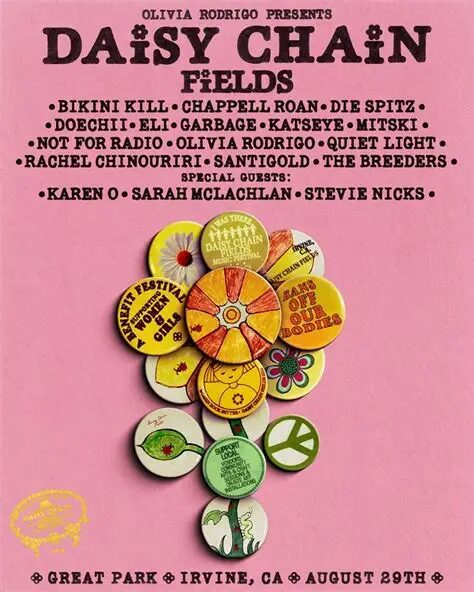
And yet, somehow, the male ego still found a way to bruise itself against the doorframe.
Because that is the sickness of the male-centric view of the world. It does not simply want access. It wants default status. It wants every stage to be available, every conversation to be open, every line-up to be balanced only when balance means men remain central. The moment women get something for themselves, even something explicitly designed to address decades of imbalance, somebody will appear to ask why men have been left out.
That softness is exhausting.
There has to be a way for men to enter these spaces without needing to own them.
There has to be a way to listen without demanding reassurance.
There has to be a way to be challenged without mistaking discomfort for persecution.
Because men should be listening to these artists. Straight men especially should be listening. Not because buying a gig ticket is a political education in itself, but because these voices are necessary. They are funny, furious, generous, difficult, joyful, confrontational, and alive.
They make the world bigger.
And too many traditional male spaces make the world smaller. Smaller emotions. Smaller colours. Smaller conversations. Smaller permission structures around what you are allowed to love.
I do not want that. I do not want to be trapped in a version of masculinity that can only appreciate women if they are soothing, sexy, silent, agreeable, or filtered through male approval. I do not want to pretend that the only serious art is art that flatters male seriousness. I do not want my taste dictated by men who think sincerity is embarrassing and camp is a threat.
I want the fury.
I want the glitter.
I want the sadness.
I want the women with guitars, synths, fiddles, eyeliner, cowboy hats, impossible voices, religious trauma, queer joy, bad decisions, good jokes, and absolutely no interest in making themselves smaller for my benefit.
And if that makes me strange, fine.
At the Sofia gig, after the “grown ass men” comment, after I raised my arms and cheered, after the women behind me tapped me on the back and gave me their approving thumbs up, I felt something I do not always feel in traditional male spaces.
I felt comfortable.
Not centred. Not catered to. Not congratulated.
Just comfortable.
Maybe that is the lesson. Maybe the point is not that every room has to be for me. Maybe the point is that a room does not have to be for me to be worth standing in. Maybe grown ass men would be better off spending more time in rooms where the songs are not written to flatter us.
And maybe, just maybe, the strange thing is not that I was there in a Sofia Isella T-shirt.
Maybe the strange thing is that more grown ass men were not.
Leave a Reply